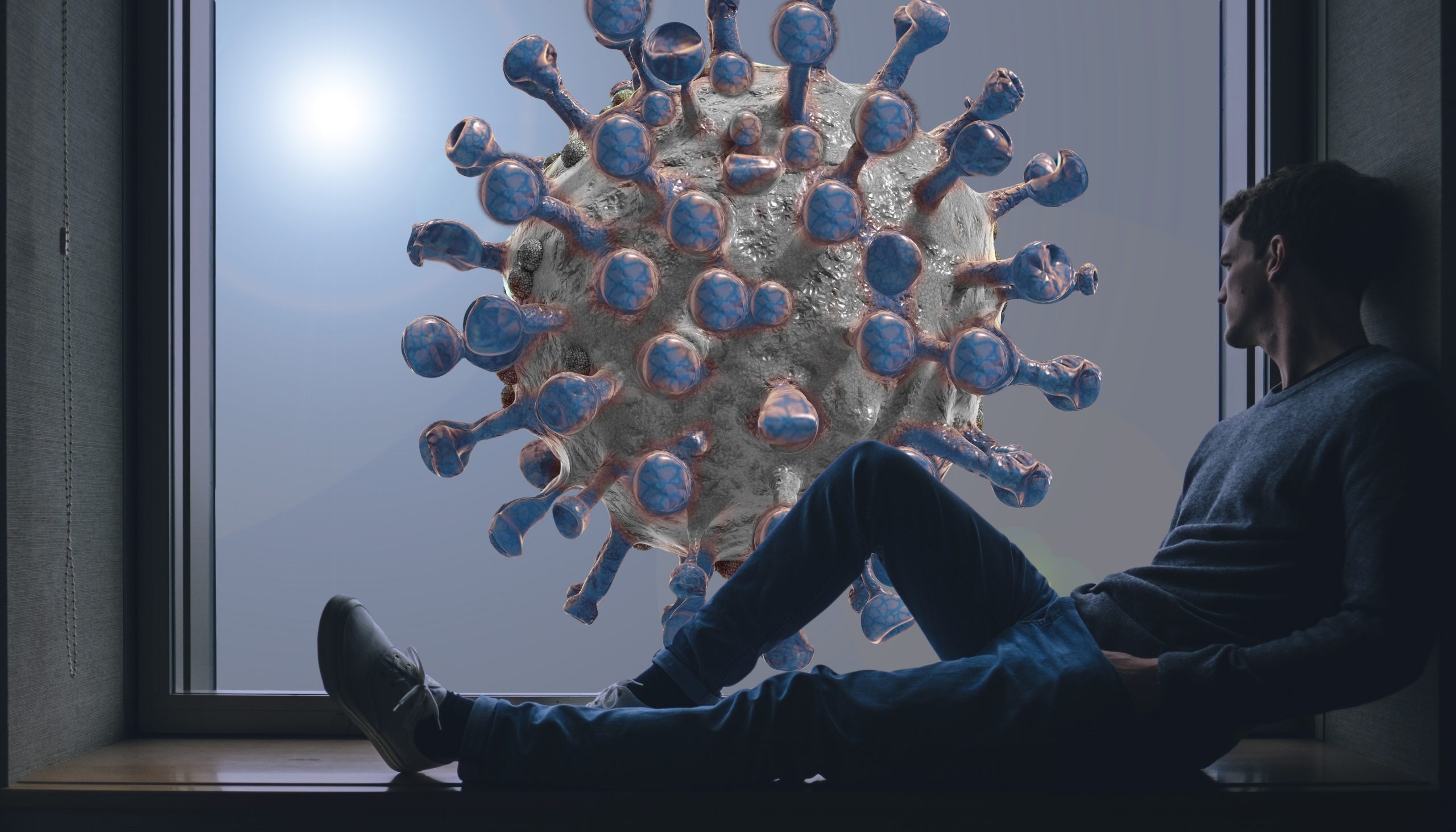
“I found myself in a dark forest…”
How to cope with pandemic stress and depression.
by Carmelo Rinaudo
The Sars-Cov-2 pandemic not only endangers physical health and life itself but also poses a serious threat, predictably increasing over time, to mental health. In fact, the health emergency, as in previous pandemics, also registers the prevalence of certain psychopathological conditions, such as PTSD (Post-Traumatic Stress Disorder), in the highest risk groups (frontline health workers, individuals who have experienced illness, loved ones, or the loss of loved ones) and the increase and worsening of mental disorders in the general population: anxiety disorders with hypochondriac and pathophobic alarm, depression, adjustment disorders, and alcohol abuse. A relevant increase in psychiatric morbidity, particularly depression, is to be expected, even after the gradual exit from lockdown, as a consequence of the prolonged allostatic burden fueled by adaptive needs, conditioned, predictably for not a short time, also by the non-health consequences of the pandemic (living habits, social relationships, work, economic problems, transportation, etc.). A recent review published in Lancet [1] of a series of studies on the effects of quarantine on the general population found that conditions of psychological distress include PTSD, anxiety, demoralization, anger, aggression, and highlighted prolonged quarantine, fear of contagion, frustration, inadequate care, inadequate information, financial loss, and stigma as stressors. In the post-acute phase of the COVID-19 emergency, anxiety frameworks then predominantly evolved into depressive frameworks and adjustment disorders with increased suicides and violent behaviors [2]. Thus, not only physical health but also mental health is at risk due to coronavirus. Experts in many countries have observed the increase in depression among the population as a result of long isolation, and a United Nations report calls on national governments to take charge not only of the risk to physical health but also to mental health. Devora Kestel, Director of WHO’s Mental Health Department, sounded an alarm about the consequences of the pandemic for mental health as well, urging governments to put the issue at the forefront. Moreover, as reported by Reuters, Michael Ryan, Executive Director of WHO’s Emergency Program, during an online briefing, at a time when the world is debating how to break out of the lockdown to restart a global economy brought to its knees by Covid-19, warned about the possibility that the coronavirus could become as endemic as HIV and urged continued vigilance for unpredictable times. Thus, the risk of prolonged exposure of the population to significant stress load and stress-related diseases. In particular, the correlation between stress and depression (systemic, mind-body pathology with somatic, affective and cognitive symptoms) is clinically well known and refers to the neurobiological mechanisms that may mediate the dysfunctional, depressive response to allostatic overload. Ongoing overload fueled by the need for an adaptive effort imposed by radical changes in daily life, behavioral styles, and, in particular, in existential planning that has been profoundly altered, temporarily suspended, or needs to be profoundly refoundened.
Allostasis is the ability to maintain the stability of physiological systems by means of change; when the stresses of the physical and social environment exceed the limits of the individual’s homeostatic resilience, both physical and mental, the condition of allostatic overload with possible pathological consequences (stress pathology), referable to the “exhaustion phase” of Selye’s theory of general adaptation syndrome, is realized. Under physiological conditions, the activation of the hypothalamic hormone and neurotransmitter CRH (Corticotropin-Releasing Hormone) or CRF (Corticotropin-Releasing Factor) triggers the adaptive stress response along the hypothalamic-pituitary-adrenal axis by facilitating functional coping responses and the tendency to develop adaptive behaviors ranging from the simple “fight-or-flight” response to articulate and complex emotional-affective responses, cognitive, and proactive behavioral responses aimed at restoring homeostatic, physical, psychological, and social balance. When allostatic overload is determined, especially from prolonged or chronic stress, the stress response is then dysfunctional and maladaptive. In such cases, allostatic stresses, rather than prompting, inhibit the proactive motivational level and action by fueling feelings of frustrating helplessness, dulling of the ability to feel pleasure and infuture. Moreover, the same depressive condition determining, in turn, the reduction of individual resilience represents a factor of vulnerability to stress with the triggering of circular causality. In this regard, in the “Advice for public” Section [3] of the WHO website, at the same time as the infographics related to the behaviors to be adopted for the prevention of COVID-19 infection, those for coping with stress have also been published:
“How to cope with stress during 2019-nCoV outbreak.”
Feeling sad, disoriented or worried during a crisis such as the current one may be considered an understandable discomfort but the appearance, especially in the current phase of progressive exit from lockdown, of growing malaise with feelings of helplessness, volitional and motivational inertia, prevailing regret for the before with experiences of loss, weakening of purposeful drives for necessary changes in infuture, reduced ability to desire and feel pleasure, should promptly prompt clinical attention with timely and qualified therapeutic interventions. Also in view of the fact that it is to be expected precisely when, as now, we are forced to be more aware of our fragility and precariousness a physiological sharpening of desire and drive for life; the affirmation of the happiness of living to which Henry Miller provocatively urges in his novel Tropic of Cancer, an important masterpiece of 20th century literature but banned, because it was considered pornographic and scandalous, for some 30 years in the USA:
“I have no money, no resources, no hope. I am the happiest man in the world.”
In view of the fact that for an unforeseeable time we will continue to be confronted with pervasive changes in our being-in-the-world, it is appropriate to realistically review our priorities and accept, mobilizing energies and skills, the challenge of change rather than clinging to the sometimes unrealistic expectation of restoring exactly what has been thus running the risk of increased exposure to frustration and experiences of loss. It is necessary, in order to proactively orient ourselves in change, to nurture the attitude of desiring, in the literal meaning of the term [4] of realistic and purposeful appetition, to emerge from the “dark forest” of COVID-19 like Dante from the Inferno of his journey: “And so we went out to see the stars again.”. The journey must continue in the best “possible” way.
- Brooks SK, Webster RK, Smith LE, Woodland L, Wessely S, Greenberg N, Rubin GJ. The psychological impact of quarantine and how to reduce it: rapid review of the evidence. Lancet. 2020 Mar 14;395(10227):912-920.
- Jianbo Lai, MSc; Simeng Ma, MSc; YingWang, MSc; Zhongxiang Cai, MD; Jianbo Hu, MSc; NingWei, MD; JiangWu, MD; Hui Du, MD; Tingting Chen, MD; Ruiting Li, MD;Huawei Tan, MD; Lijun Kang, MSc; Lihua Yao, MD; Manli Huang, MD; HuafenWang, BD; GaohuaWang, MD; Zhongchun Liu, MD; Shaohua Hu, MD. Factors Associated With Mental Health Outcomes Among Health CareWorkers Exposed to Coronavirus Disease 2019 JAMA Netw Open. 2020 Mar 2;3(3):e203976
- https://www.who.int/emergencies/diseases/novel-coronavirus-2019/advice-for-public
-
The term wish is composed of the preposition de, in Latin with a negative meaning, and sidus , star; thus, literally, lack of stars, in the sense of feeling the lack of the stars that enable sailors to stay on course, Of good omens, good wishes. By extension, wishing has also taken on the current meaning as a perception of a lack and, consequently, as a feeling of passionate and purposeful pursuit. All three canticles of the Divine Comedy end with the word “stars” (Inferno: “And so we went out to see the stars again“; Purgatory: “Pure and willing to ascend to the stars“; Paradise: “L’amor che move il sole e l’altre stelle“).
Author