

OMOMIND CPR is a food dietary supplement based on Homotaurine (150mg) and Vitamin D3 (37.5 mcg/1500 U.I.) Useful in slowing down cognitive decline and the early stages of dementia.
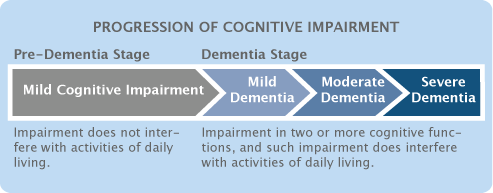
Mild cognitive decline or mild cognitive impairment (MCI)
Mild cognitive decline is a transitional state between physiological aging and the more severe form of dementia.
Symptoms include memory lapses, mild language and operating functions impairment without affecting normal daily activities.
MCI conversion rate to dementia is about 20% per year.
MAJOR NEUROCOGNITIVE DISORDER OR DEMENTIA
Major neurocognitive disorder is a set of disorders that worsen over time (chronic-degenerative) and manifest with certain symptoms.
The result is compromised:
- language
- memory
- learning
- orientation
- understanding
- behavior
- The ability of calculation and judgment
These symptoms significantly interfere with a person’s ability to maintain daily and social routines.
Major neurocognitive disorder is progressive and is divided into three stages: mild dementia, moderate dementia, and severe dementia based on the severity of symptoms.
The patient may begin to behave unusually.
It becomes more difficult to eat, drink, and stay active resulting in muscle weakness and weight loss.
The origins of Alzheimer’s disease
Mechanisms underlying the development of the disease
OMOMIND CPR TABLETS

WHAT IS HOMOTAURINE (TRAMIPROSATE)?
It is a low molecular weight sulfonate compound extracted from different species of red seaweed and later chemically synthesized to introduce it into the pharmaceutical market.
Homotaurine plays a key role: it can slow cognitive decline, improve memory, and protect the brain from aging and oxidative stress.
It is the only natural substance to have reached a phase 3 clinical trial for its positive effects on Alzheimer’s patients.
Homotaurine does not interfere with Cytochrome P 450 and is eliminated hepatically.
Its dual neuroprotective effect related to inhibition of excitotoxicity, neuroinflammation, and oxidative stress on the one hand and regulation of gene expression, energy metabolism, and proper protein folding on the other hand has been studied.
Homotaurine binding through its sulfonate end to peptide Aβ has been shown to block the molecular transition of the peptide from a “random coil” structure to a β-sheet structure and its subsequent oligomerization with formation of neurotoxic compounds.
There are no adverse effects and it is safe and well tolerated.

RISK FACTORS


HIGH HOMOCYSTEINE LEVELS AND BRAIN DAMAGE
- Progression of cognitive decline in paraphysiological aging
- Conversion of cognitive impairment to dementia
- Increases cognitive decline in patients with Alzheimer’s disease
- Triggers excitotoxicity
- Promotes the β- amyloid accumulation
- Enanches the rate of brain atrophy
VITAMIN D DEFICIENCY
The Italian Society of Osteoporosis, Mineral Metabolism and Skeletal Diseases (SIOMMMS) claims that 80% of the population in Italy is deficient in vitamin D and that the deficient condition would increase with advancing age until it affects almost the entire elderly population.
Vitamin D deficiency is a risk factor for the development of cognitive decline and dementia in the elderly.
Elderly subjects with reduced vitamin D levels have a 2-4 times higher risk of developing cognitive impairment.
The receptor for vitamin D is particularly expressed in brain areas most affected in dementia.
Vitamin D reduces the phenomena of neuroinflammation and counteracts the neurotoxic action of β-amyloid by limiting its accumulation and facilitating its elimination.
The recommended dose of vitamin D ranges from 1500 to 2000 IU per day.
OMOMIND CPR contains 37,5µg of cholecalciferol (vitamin D3), which corresponds to 1500 units.
It is recommended to take one tablet per day, preferably in the morning, on a full stomach.

